


Rudy Hernandez is a realist. The veteran boxing trainer from Los Angeles knows that all it takes is one punch to derail an otherwise promising career.
And it's not always an opponent that keeps a fighter with elite skills from realizing his potential, Hernandez pointed out.
"I've always believed and have always had the attitude that today is today and that we should live for today and think in the moment and not worry about what happened in the past or what might happen in the future," he said. "How many times have you seen it, a kid is looking great in the gym and you're thinking, 'Wow. This guy is going to really be a champion and be something else,' and then a girl comes along and 'Boom,' that's it? You see it a lot, with girls and a lot of other distractions."
There's always a but, though, and Hernandez's theory explains why there is suddenly a flood of elite boxers coming out of Japan. Undisputed super bantamweight champion Naoya Inoue (27-0, 24 KOs), who defends his belts on Sept. 3 at Ariake Arena in Tokyo against T.J. Doheny, has become arguably the greatest fighter in the world.
Inoue has been undisputed champion at both bantamweight and super bantamweight and held world championships at light flyweight and super flyweight. He's become so big in Japan that he drew more than 55,000 to the Tokyo Dome for his last fight, a KO of Luis Nery. That fight had gate that exceeded $20 million U.S.
Inoue is No. 3 pound-for-pound at KevinIole.com, but an argument could be made that he deserves to be No. 1.
But there are at least five Japanese boxers who are elite and could be considered in the pound-for-pound rankings. WBC bantamweight champion Junto Nakatani, who is trained by Hernandez and is 28-0 with 21 KOs, is ranked ninth. Light flyweight champion Kenshiro Teraji is 23-1 with 14 KOs. Super flyweight champion Kosei Tanaka is 20-1 with 11 KOs.
Kazuto Ioka lost his last fight, but he's one of the greats of recent vintage and held titles in four weight classes.
Elite fighters are popping up all over Japan. They're attracting huge crowds -- "They have shows there on Tuesday and they sell out on Tuesday nights and here [in the U.S.], we can't sell out on a Saturday," Top Rank vice president Carl Moretti lamented -- and they're being developed into stars.
It's cultural to a degree, both Moretti and Hernandez said.
"Guys over there, they aren't worried about all the social media bullshit and who is bigger and this and that," Moretti said. "They go to the gym and they work to get better. They want to improve and learn and that's what they do."
Hernandez said he met Nakatani in Los Angeles when the champion was 15. His talent was obvious and Hernandez was eager to work with him.
But what surprised him was the way Nakatani goes about his business every day.
"From Day 1, this kid was always focused on boxing," Hernandez said. "And to this day, he's never put anything ahead of boxing. He comes to the gym and he's the hardest worker. He's there to learn and get better. He's a three-time world champion but you'd never know it. He's the most humble, hard-working kid there is."
Inoue came to the U.S. in 2020 and had fights in Las Vegas in 2020 and 2021 in a bid to help shine a spotlight on boxing in Japan. He probably would have made more money had he stayed in Japan and fought in front of the home crowd, but he felt a responsibility to the sport in Japan to try to build its reputation.
It worked, and now the stars from other parts of the world willingly flock to Japan to fight the elites there. They know there will be big crowds and huge paydays awaiting them.
And in Japan, the weight classes don't matter. The public there appreciates a light flyweight as much as a heavyweight. The Japanese fans adored former undisputed heavyweight champion Mike Tyson, which is why he fought Tony Tubbs and Buster Douglas in Tokyo.
But their interest in boxing covers all weight classes.
"It's so hard over here to see a flyweight," Moretti said. "People just don't have interest. Over there, if they can fight, it doesn't matter what class they're in. Here, it's pretty much a welterweight, middleweight, heavyweight and lightweight kind of a thing. It's really difficult to sell those guys under featherweight over here, but Japan loves them."
Moretti said a dream would be to have Inoue come back to the U.S. to fight Nakatani at Madison Square Garden sometime next year. While that's no sure thing, it's at least a possibility. Top Rank founder Bob Arum said he'd love to see it in Las Vegas.
Arum said MGM Resorts president Bill Hornbuckle has expressed interest in having Inoue fight at either the MGM Grand Garden or T-Mobile Arena next year. Don't expect it to slow any time soon, however.
Hernandez said he'd love the fight and said it would be best at 122, perhaps late next year.
If it happens, it'll be a treat for American boxing fans.
"Inoue kind of opened the doors and so many others followed him," Top Rank president Todd duBoef said. "Other [Japanese] kids saw him and what he was able to do and they followed him. The system there is so well set-up. There are a lot of great trainers and their fighters are being taught well. There's good sparring. There's a lot of support for the spot.
"And all these kids want to do is fight, win and put on a good show."
In the process, they're getting massive television ratings locally and building a sustainable long-term sport.
Arum, though, said it all revolves around Inoue.
"This kid is unbelievably special," Arum said. "Nobody's going to beat him. He is one of the greats. Everything you want to see in a fight, he can do. I've been at this a long, long time and I can count how many times I saw someone like him."
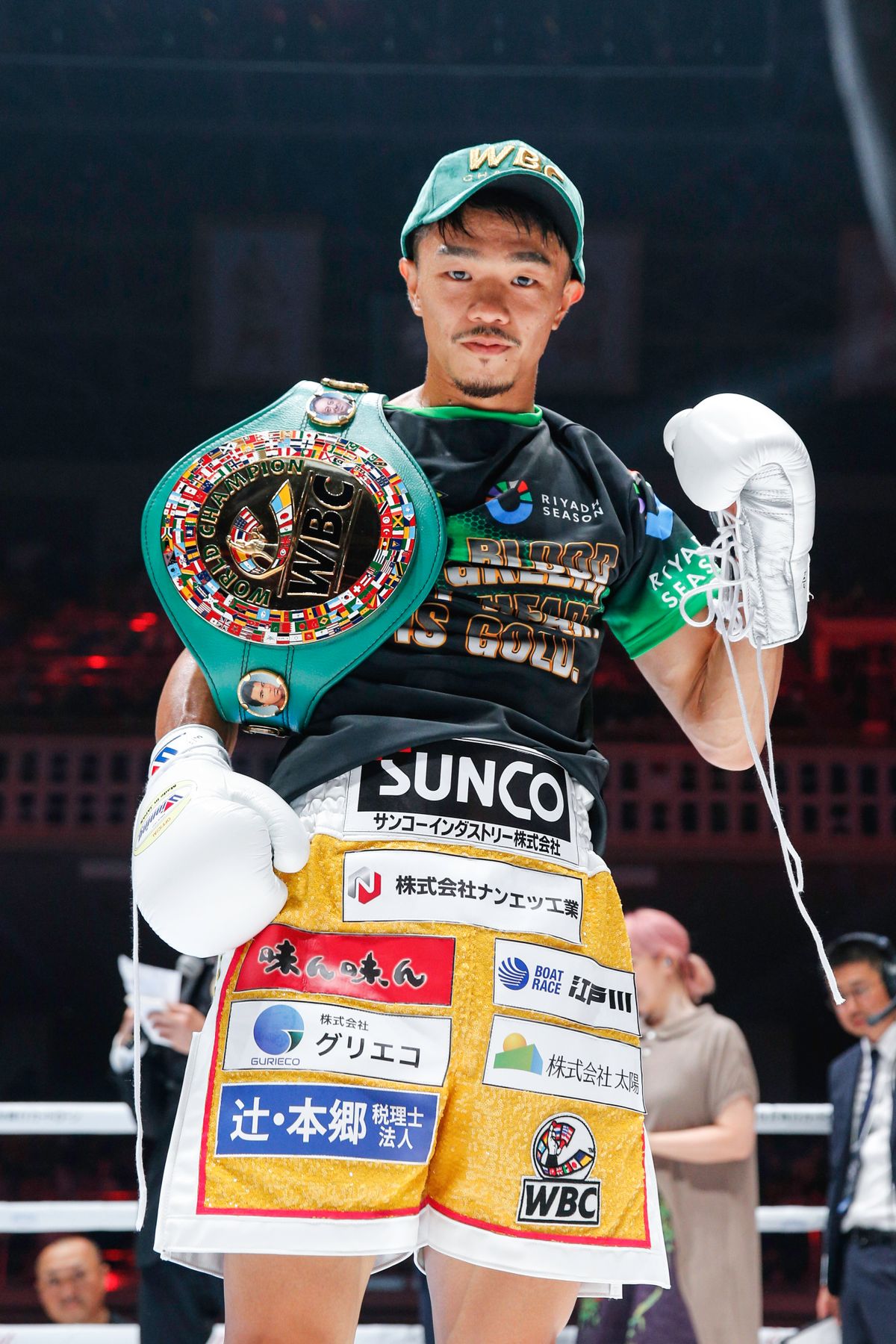
Wendell Alinea/MP Promotions
Junto Nakatani is 28-0 with 21 KOs.