


I almost could hear Frank Sinatra singing the opening of “My Way” as I read through the disturbing 36-page lawsuit boxing manager Billy Keane filed against Top Rank and company president Todd duBoef in a California federal court on Thursday.
Reading some of those allegations, you got the feeling that no matter how this thing goes, it signaled the end of something.
And now, the end is near
And so I face the final curtain
Is this the beginning of the end for Top Rank, founded in 1966 by the legendary Bob Arum and the entity which promoted Muhammad Ali, George Foreman, Sugar Ray Leonard, Marvelous Marvin Hagler, Roberto Duran, Thomas Hearns, Oscar De La Hoya, Floyd Mayweather and Manny Pacquiao?
With no TV agreement beyond August, since ESPN informed Top Rank it won’t renew the deal between them that began in 2017, it sure looks like it might be.
Is it the end for duBoef, Arum’s step son, who has been Top Rank’s president since 2004 and has taken on an increasingly larger role in recent years as Arum has aged? Potentially.
Arum is a lion with a fighter’s heart, one as big as any of the great champions he’s ever promoted. For decades, he’s fought, fiercely, whenever he’s faced a challenge.
He turned 93 in December, and it’s fair to wonder if he is up for a fight of this magnitude at this stage of his life. Does he sell off the assets and close up shop and enjoy the remainder of his life with his wife, Lovee?
It’s important to note that Keane’s side is out in the form of a 36-page lawsuit filled with salacious allegations. Top Rank’s defense has yet to be made, and as is common business practice, its executives declined comment regarding ongoing litigation.

Mark Robinson/Matchroom
Top Rank heavily pursued Tyson Fury, despite knowing he was affiliated with alleged mobster Daniel Kinahan.
But if Keane’s lawsuit is really a peek behind the curtain, it’s a disturbing eyeful that sounds a lot like what happened in Watergate: Secret deals with unsavory characters and then unsuccessful attempts to cover one’s tracks.
The heart of the lawsuit is this: In 2018, as Top Rank was deep in talks with ESPN to extend the deal, Arum realized he needed more big-name fighters.
He reached out to Keane, who at that point was managing boxers, to solicit his help in building Top Rank’s stable.
Keane had been around boxing a long time and knew fighters. There’s nothing wrong so far. But then you see a line from Keane’s suit and you get a sense of where this is going.
“Arum told Keane he was the perfect fit because he knew how to relate to fighters, and Top Rank needed an outsider to approach fighters so Arum could maintain plausible deniability in case any other promoters were to accuse him of tampering,” the suit said. “He also explained that although Keane would be working for him and Top Rank exclusively, Top Rank needed to create the impression that Keane was an independent free agent.”
Hiring a consultant is standard practice. But why the skullduggery and the back room secrecy? If you don't deal with reputed mobsters, then guess what? You don't have to hide said fact from your business partner.
There was no need for Top Rank to interfere in any fighters’ contracts. Keane is a personable guy with a big phone book. He knows now and knew in 2018 who the players are.
Why not have Keane out openly recruiting and doing things above board? Instead, if this allegation is true, it’s Arum tacitly telling Keane to interfere in existing contracts between fighters and their promoters.
Actions like these are how $25 million lawsuits come about.
Keane alleges he made a deal with Arum in 2018 but that duBoef assumed control of it later.
Keane says duBoef cut his fee from 10 percent to five, but when duBoef failed to live up to that, Keane said his fee reverted back to the original 10 percent.
The suit says Top Rank owes Keane $25 million or more in unpaid fees. He’s also seeking interest and punitive damages.
It reads like a spy novel, but this is real life. Top Rank was knowingly doing business with Daniel Kinahan, an Irish boxing promoter whom the U.S. government has long said is the head of a drug cartel. It made no attempt to hide that.
In 2022, the U.S. Treasury Department Kinahan is a member of the Kinahan Organized Crime Group along with his father, brother and others.
Is there really a need to deal with mobsters, or mob associates? There are talented and entertaining fighters in every corner of this globe, and not all of them are aligned with a reported drug cartel leader.
It was sheer arrogance to think one could walk a fine line and deal with a notorious mobster on an upfront and ethical basis.
Someone in Top Rank, or multiple someones, panicked as the deal with ESPN progressed. Word filtered back to them that ESPN brass was unhappy with what they were getting.
Imagn Images
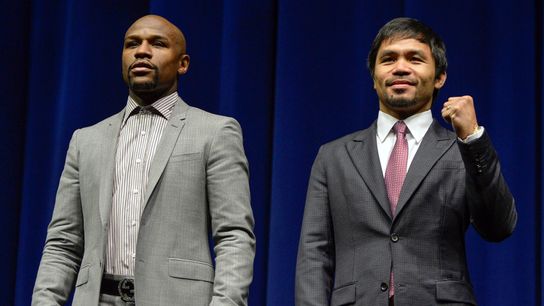
Floyd Mayweather and Manny Pacquiao each were once promoted by Top Rank.
As the inaugural deal was between Top Rank and ESPN was close to being finalized in 2017, Top Rank aired a Manny Pacquiao fight on ESPN on July 1, 2017. The bout, which Pacquiao lost to Jeff Horn, did enormous ratings. Shortly after, the companies signed a four-year rights deal.
The next year, it was extended through August 2025 and would pay Top Rank $90 million annually.
Keane’s suit said ESPN wasn’t happy with what it was getting from its partner as the deal progressed. There were less and less fights involving fighters with big names and the optimism that abounded at the beginning of the deal with the Pacquiao-Horn ratings success wilted.
ESPN earlier this year announced it was ending its rights deal with Major League Baseball and won’t renew its contract with Formula 1. The decision to not renew Top Rank was not an isolated one.
But that news breaking put Top Rank in a difficult spot, as it had to shop for a new broadcast partner. Now, Keane’s lawsuit could destroy any progress Top Rank has made on a new rights deal.
What company is going to want to do business with Top Rank when it’s in the middle of a mess like this?
It’s important not to take Keane’s suit at face value and as absolute fact. It’s an allegation and when millions of dollars are at stake, people do strange things.
Not much, though, is stranger than legitimate business people dealing with alleged drug cartel members. As far back as 2009, a cable was sent from a U.S. Embassy in South America to the Pentagon referring to Kinahan as “a suspected international drug-trafficking figure.”
When you work with people with reputations like that, lawsuits like Keane’s become a part of doing business.
Keane still has to prove his case in court. But it’s incontrovertible that Top Rank was doing business with Kinahan even before Keane was involved.
It's that kind of judgment, or lack thereof, has proven to be a problem.