


It seemed like it took 10 years to make the fight between Floyd Mayweather Jr. and Manny Pacquiao. Now, just days away from the 10th anniversary of one of boxing’s most hyped — and ultimately disappointing — bouts, it’s worth remembering what it meant.
If you were a boxing journalist any time between, oh, 2008 and 2014, you were asked one question repeatedly: “Will Mayweather and Pacquiao ever fight?”
They did, eventually, after much angst and making the sport look foolish and minor league, on May 2, 2015, at the MGM Grand Garden Arena in Las Vegas.
Boxing has changed greatly since that night, in many ways for the better.
On this coming Friday, Ring Magazine will stage a three-fight card outdoors in Times Square. It was a show that came together quickly, a far cry from the days when making the biggest fights required years of stalling, bickering, and posturing.
Ryan Garcia and Devin Haney fought on April 20 at Brooklyn’s Barclays Center — a controversial bout that led to Garcia’s one-year suspension for PED use and sparked a public mental health spiral that ultimately ended in his arrest.
Garcia has taken steps to rehabilitate himself, and his one year suspension is over. He’ll headline Friday’s show, with the goal for a rematch with Haney later this year if both win on Friday.
Garcia faces Rolando Romero; Haney meets Jose Ramirez; and Teofimo Lopez takes on Arnold Barboza on Friday’s unique Times Square card, the brainchild of Ring owner and Saudi businessman Turki Alalshikh.
The fight that wasn’t
There was a strange duality throughout the Mayweather-Pacquiao build-up. The fight did extraordinary business, generating over $600 million in gross revenue and selling a record 4.6 million on pay-per-view.
The fight, which drew millions of casual and lapsed fans, turned out to be a dud. Pacquiao landed just 81 punches in 12 rounds, connecting on less than 20 percent of his shots.
Former heavyweight champion Mike Tyson tweeted, “We wanted 5 years for that…#underwhelmed.”
We waited 5 years for that... #underwhelmed #MayPac
— Mike Tyson (@MikeTyson) May 3, 2015
Mayweather was brilliant defensively. Pacquiao fought with an injured shoulder that required surgery. While there is no doubt about Mayweather’s magnificence, the fight failed to come close to matching the hype.
It was like a get-rich-quick scheme and not a sporting event.
Pacquiao filmed a commercial as he walked to the ring, and Mayweather couldn’t stop talking about how much money he was making. After the post-fight news conference that night, which was held in the ring, Mayweather walked toward me at ringside.
He nodded for me to come over and opened his jacket and pulled out an envelope. “Check this,” he said.
And he showed me a check made out to him for $100 million. He made more than twice that amount when all revenues were considered. Pacquiao made more than nine figures, as well.
But while people talk with a reverence about matches like Thomas Hearns versus Marvelous Marvin Hagler, Muhammad Ali versus Joe Frazier or Diego Corrales versus Jose Luis Castillo, there is a disdain when referring to the Mayweather-Pacquiao fight.
Numerous lawsuits were filed in its aftermath after news broke that Pacquiao fought with an injured shoulder.
Instead of lifting the sport, the fight turned out to hurt it. Fans were outraged that tickets didn’t go on sale until about a week before. Hotel rooms on the Las Vegas Strip were at such an inflated price that people were staying away. Room rates on the Strip were crashing faster than the stock market in 1929 in the days leading up to the fight.
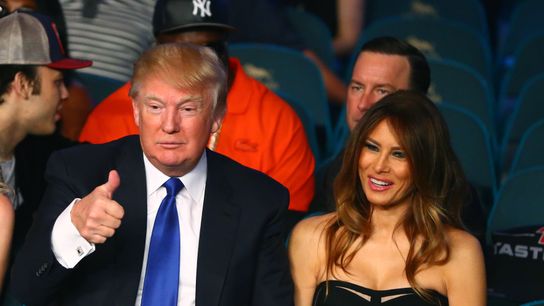
Mark J. Rebilas/Imagn Images
President Donald Trump and First Lady Melania Trump, six weeks before he announced his candidacy for the presidency, attended Mayweather-Pacquiao on May 2, 2015, in Las Vegas.
A long and winding road
The seeds of the Mayweather-Pacquiao fight were first sewn in 2008, when Pacquiao moved up from lightweight to face Oscar De La Hoya at welterweight.
Mayweather had been a welterweight since he defeated Sharmba Mitchell in 2005 and edged De La Hoya at 154 pounds in 2007.
The fight really seemed to pick up steam after Pacquiao destroyed De La Hoya on Dec. 6, 2008, in the Filipino superstar’s welterweight debut. De La Hoya was weight drained and clearly well past his prime, though, and so more impetus was needed.
Fans and media started calling for it in the immediate aftermath of Pacquiao’s vicious second-round KO of Ricky Hatton on May 2, 2009.
Overhead cameras showed Hatton out cold in the center of the ring, confirming Pacquiao’s devastating knockout power. Less than two years earlier, Mayweather had stopped Hatton in the 10th.
Once Pacquiao bested Miguel Cotto on Nov. 14, 2009, in Las Vegas, talks began in earnest to make a fight with Mayweather.
It’s one of modern boxing’s great shames that it took six years to make such a potentially spectacular bout. The fighters won because of the money, but the fans lost because they didn’t get the great fight they paid for.
And while it did extraordinary business, it did little for either fighter’s legacy.
No one remembers Ali as the guy who couldn’t move in 1980 and was battered by Larry Holmes. Nor do they remember De La Hoya as the stiff punching bag who was easily taken apart by Pacquiao. And no one thinks of it as the real Tyson who lost to Kevin McBride in 2005.
Mayweather’s win is tainted by the fact that many believe Pacquiao got old. Pacquiao’s reputation is tainted because he could barely lay a glove on Mayweather.
Had they fought in 2010, though, when both were clearly at their primes, we might have been talking not about one of the biggest nights financially, but one of the biggest nights competitively in boxing history. Boxer versus slugger. Mayweather versus Pacquiao. A matchup that had the power to change the course of an entire sport.
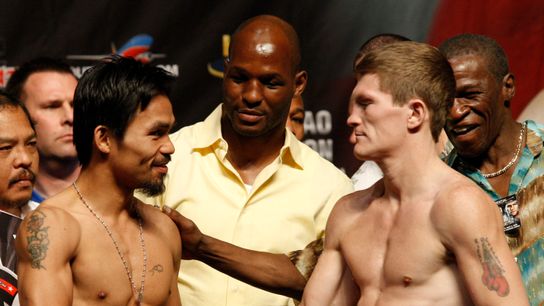
Ed Mulholland/Imagn Images
Manny Pacquiao (L) knocked out Ricky Hatton in the second round on May 2, 2009, in Las Vegas.
They waited too long, clouded by greed, and they lost their moment to establish a legacy that crosses generations.
Both are among the greatest fighters who ever lived. Both are enshrined in the International Boxing Hall of Fame.
Anyone, though, who watched carefully knows that fans missed out on a potentially epic battle for reasons that a decade later, still don’t make sense.
Changing for the better
Boxing is vastly different now than it was when Mayweather and Pacquiao ruled the game. Neither HBO nor Showtime, which collaborated on that pay-per-view production, broadcast boxing any more. ESPN’s future in the sport is questionable, at best.
Boxing’s largely gone streaming now, with DAZN showing the bulk of the cards in the U.S.
Gone are what boxing insiders remember as “the other side of the street,” battles, when if you fought for HBO, you couldn’t face anyone who fought for Showtime and vice versa.
Even promotional lines are crossed regularly and the promoters tend to work with each other more than they did in the first 15 or 20 years of this century.
That’s in large part due to Alalshikh, the chairman of Saudi Arabia’s General Entertainment Authority, who has pumped hundreds of millions of Saudi money into the sport.
The best are now fighting the best on a more regular basis.
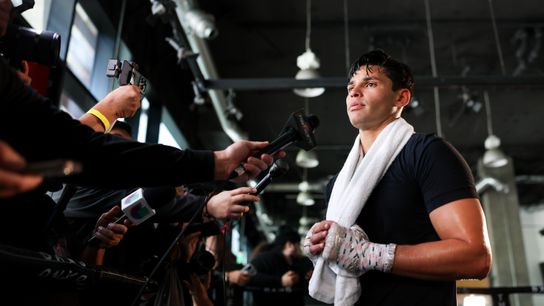
Courtesy Golden Boy Promotions
Ryan Garcia speaks to the media at a San Diego workout ahead of his fight on Friday in Times Square against Rolando Romero.
Thanks to Alalshikh’s involvement, we’ve seen, or soon will see:
• Oleksandr Usyk and Tyson Fury fight twice, once for the undisputed championship and once for three of the four sanctioning body belts.
• Artur Beterbiev and Dmitry Bivol meet twice for the undisputed light heavyweight championship.
• Usyk fought Anthony Joshua twice for a version of the heavyweight title.
• Daniel Dubois faced Joshua for the IBF heavyweight strap.
• Vergil Ortiz met Israil Madrimov for a super welterweight crown.
• If Canelo Alvarez defeats William Scull on Saturday, he’ll fight Terence Crawford on Sept. 13 in what should be an epic match.
In addition, in bouts not directly funded by Alalshikh but made in part due to the momentum that money has created, we’ve seen Crawford fight Errol Spence for the undisputed welterweight title, Naoya Inoue fight for two undisputed belts and Garcia fought both Gervonta Davis and Haney.
The Alalshikh effect
Alalshikh is investing significantly in the venues — after the card in Times Square, he’s promising one at Alcatraz — and on creating Hollywood-style trailers promoting the events.
There is more competition for boxing than ever before. In its heyday in the U.S., from 1920 to 1960, there were three main sports in this country: Boxing, baseball and horse racing.
Boxing thrived through the Great Depression, World War II and the Korean War.
But as the NFL and NBA grew in popularity, as first television and then the internet allowed more entertainment options to be brought directly into our homes, and as boxing’s business problems mounted, the sport took a precipitous fall.
Boxing went from a staple on over-the-air network television, to cable, to premium cable and now to streaming. Fans wanted great bouts for their hard-earned dollars and often weren’t getting them, or had to wait years.
That, though, has begun to change.
The Mayweather-Pacquiao fight didn’t have the hooks to drag the sport along with it to the next level. It left many disgruntled, angry and disillusioned not only with the business aspects of the sport, but also with the competitive aspects.
Fighters, now, recognize that competing against the best makes them a more valuable commodity, and that it makes little sense to protect an unbeaten record by facing second- and third-tier opposition.
There are problems facing boxing — there will probably always be problems facing a sport without a central leadership or ruling authority — but things are better.
Now, 10 years after “The Money Fight,” turned so many off with its blatant cash grab, millions have been invested in making the fan experience better, putting better fights and promoting the shows better and to a more diverse audience.
The show in Times Square, followed by Alvarez-Scull in Riyadh, Saudi Arabia on Saturday, and Inoue-Ramon Cardenas on Sunday is an example of all of that.
Five of the sport’s brightest stars — Garcia, Haney, Lopez, Alvarez and Inoue — compete in separate bouts over a 72-hour period. All have significant implications for potential future bouts.
A decade later, the scars of Mayweather-Pacquiao linger — a fight that promised to define an era, but instead revealed that money trumped all, even competition in a once great sport.
Yet out of that void, something new has emerged. The sport, once trapped in ego and politics, is rediscovering what made it great: the best facing the best, for legacy, not just money.
In Times Square, under neon lights and skyscrapers, boxing isn’t just remembering what it was — it’s showing us what it can still become.
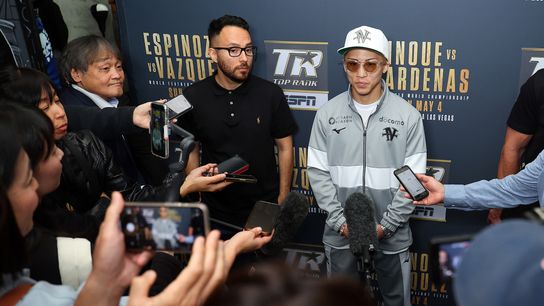
Mikey Williams/Top Rank
Undisputed super bantamweight champion Naoya Inoue will defend his title on Sunday against Ramon Cardenas in Las Vegas.