


Saudi Arabia's General Entertainment Authority has been spending money on boxing for more than five years now, but it really wasn't until 2023 when fights were added to "Riyadh Season" that the involvement began to have an impact on more than the bank accounts of the fighters and promoters involved.
Turki Alalshikh, the chairman of the General Entertainment Authority, has done what has been seemingly impossible and put together a series of significant fights that previously seemed to be impossible to make. He brought promoters Frank Warren of Queensberry and Eddie Hearn of Matchroom, who hadn't spoken for years and previously hated each other, together. They're like long-time friends now.
It's a great step, but it's only a step. Boxing is not fixed, nor is it anywhere near being a mainstream sport now. There are pockets in the world where boxing is bigger than it is in other places, but it remains plagued by issues. Multiple generations have now grown up in an era where boxing is more of an afterthought that, at best, is relevant for a couple of nights a year.
The more interest the sport has, the more money it generates. And the more money it generates, the more attractive it is to young athletes. That will improve the quality of the sport by improving the level of the fighters. There are a lot of great young fighters coming into the sport now, but that can't be an occasional thing. And there are fighters like Naoya Inoue, Terence Crawford and Oleksandr Usyk who would have been elite in any era, but that's not nearly enough.
There are a lot of reasons for boxing's decline, but at the end of the day, it all revolves around the lack of a central authority. The rules are different from jurisdiction to jurisdiction. There is no one who can rule on disputes. Sanctioning bodies have enormous power and influence in certain countries and none in others.
Boxing is a worldwide sport, but it's a lot like the wild, wild west. People do what they want, don't follow any rules or organized procedures and don't care about the overall health of the sport. They care about a score on one night.
So, the first thing the stakeholders need to do is to create an entity that for the sake of argument here we'll call "Big League Boxing," or BLB, for short. Every sport has a top league where the best compete. In MMA, it's the UFC. In American football, it's the NFL. It's the NBA in basketball and Major League Baseball in baseball. Let's make it BLB for boxing.
A set of rules needs to be written, a commissioner with authority to settle disputes must be appointed and a list of criteria for membership must determined.
Once that is done, we're on the way to truly reviving this sport. There is almost nothing like it at its best, when the elite fighters are facing each other and the ring walks are beginning following a well-executed promotion. Those nights, though, are way too far and few between.
The sanctioning bodies can still be used, because fighters love to accumulate belts. That being said, their rules are inconsistent and their actions aren't always aboveboard. And so, that hurts the sport in general. One of the common complaints I hear from disaffected boxing fans is that they don't know who the champions are. And when a fighter like Crawford wins the undisputed title in the ring but then is stripped by the IBF in short order afterward, they get angry.
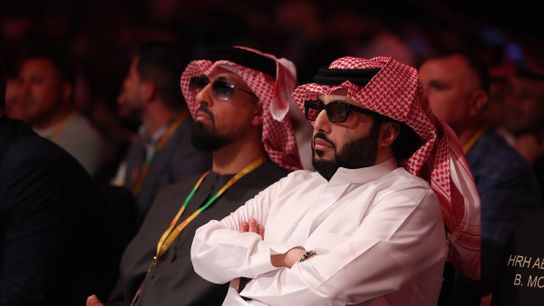
Mark Robinson/Matchroom
Turki Alalshikh, the chairman of Saudi Arabia's General Entertainment Authority, has played a big role in boxing's revival, but there is more to be done.
So BLB will award its own titles which can only be won or lost in the ring as long as a boxer complies with the BLB rules. So, when Crawford, Canelo Alvarez, Naoya Inoue and/or Oleksandr Usyk win an undisputed title, they will no longer have to worry about being stripped by one of the IBF, WBA, WBC or WBO. The BLB title will be the major one and it won't be stripped for no reason. Stripping a champion will be a move of last resort in the BLB and it will only be done if clearly outlined rules aren't followed.
Until that entity comes into existence, though, some easily changeable rules/policies could be enacted that would make boxing better for everyone. These are some of my suggestions that I believe will make it a fairer, more popular and entertaining sport.
Don't allow judges to score even rounds
I have scored fights for years, and understand as well as anyone what a difficult and thankless task it is. And in some rounds, the difference between one fighter and another is razor-thin. But 10-10 rounds are, frankly, cop-outs. There is something in a three-minute round to differentiate the fighters.
Scoring a 10-10 increases the likelihood of a draw, which no one wants. Pick a winner no matter what, and if the trade-off is to more liberally use 10-8 rounds, then so be it. Even rounds, though, are a scourge.
Bonus fighters for winning and for finishing
Fans love knockouts, and encouraging fighters to go for them adds a dimension the sport lacks. Make it financially worth a fighters' while to go after a finish, even if he/she already has a fight won.
I don't like the fact that in MMA, half of a fighter's purse is dependent upon winning. But I do want the fighters to have an incentive to try to win and to try to finish their opponents. So pay them a bonus if they win and gave them a bigger one if they won by KO or TKO.
Create a common ranking system
Each of the four major sanctioning bodies has its own ratings. They can do what they want with their belts, but create a single ranking system based on theirs along with perhaps an independent body created for such a purpose. Better, fairer rankings equal better fights.
It would be nice if the sanctioning bodies would agree to work together on this, but they uniformly refuse to do so. The least they could do is agree to rank all qualified fighters, and not omit a boxer from their rankings they'd otherwise rank because he/she is a champion of a rival organization.
Promote with everyone
Certain promoters seem to work on their own or work with fighters who are promoted only by rival promoters they've got a close relationship with. But opening and being willing to fight all comers is the essence of what boxing is all about.
Don't close doors on anyone and better fights will occur.
Make matches with the fans in mind
This is not done nearly enough, even though the fans are the ones buying the tickets, the merchandise and the pay-per-views. Too often, a matchmaker matches his fighter with the hope of keeping him unbeaten until a big money fight comes along. If we expand the interest in the sport, there are bigger fights by definition, and one of those ways to expand interest is to make the fights the ticket buyers want to see.
It seems simple, but it's rarely used in practice.
Most fans don't care about a record if they know a bout is going to be action-paced and between guys who come to fight. There's no reason to protect a zero in the loss column. Give us guys who will fight anyone, anywhere at any time, and who make fun matches when they do compete.
If, as Michael Buffer likes to say, "Somebody's oh has got to go," then make it worthwhile by having it come in a competitive fight.
Yes, 20-1 underdogs win once in a while. But let's limit the amount of 20-1, 50-1 and 5000-1 matches that are on a card now. The number that are is quite appalling.
No draws in championship fights
A significant advantage for a champion is that he/she keeps the belt in the event of a draw. As mentioned earlier, though, fans hate draws. So this idea is kind of like hockey adopting a shootout to decide games, but if a title fight is a draw, have the boxers fight a 90-second OT to settle the result.
Health and safety can't be disregarded, but a shortened round won't be too taxing. It would encourage the fighters to go hard, knowing the title hangs in the balance, and would create drama.
Promote better
The levels of promoting in the sport aren't nearly the same. If you live in the United States, Frank Warren's Queensberry Promotions acts like you don't exist and won't bother to send so much as a solitary press release. Now, dealing with the media is only one aspect of promoting, and there is a lot that could be done that isn't being done.
Yes, the fighters should be made available more often, but there is a lot of marketing and p.r. that can be done that don't require the fighters to be involved. Make the fight cards an event, and have fun things for the fans to do when they attend. Fred Sternburg, the brilliant Denver-based publicist who is being inducted Sunday into the International Boxing Hall of Fame, creates awareness for his clients where it didn't previously exist.
It can be done with the right people in charge and plenty of hard work.
Improve the broadcasts
Every broadcast can stand to be better, but the biggest issue is the pacing of cards. And this is clearly an issue on the fights in Riyadh, which take forever to put on.
There doesn't need to be so much time between bouts. Yes, there should be more between the co-main and the main event to properly set the stage for the main, but that's only on the most significant of cards. Just make them move more crisply so that fans don't turn away and not come back.
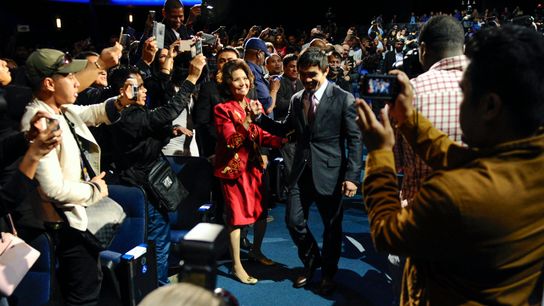
Robert Hanashiro/USA Today Sports
Manny Pacquiao arrives at the first news conference for his 2015 bout with Floyd Mayweather. Because the fight was so big, the press conference was a major event.