


LAS VEGAS -- Cub Swanson was a believer even at a moment in time that there was little reason to believe that mixed martial arts would someday be widely recognized as a mainstream sport. There was even less reason to believe the sport would ever prove profitable for the athletes.
Casino mogul Lorenzo Fertitta and Dana White purchased the UFC in January 2021 for $2 million, but on July 25, 2004, the day that Swanson made his pro MMA debut, the UFC was $40 million in debt. Fertitta had ordered White, his one-time high school classmate, to look for potential buyers.
Swanson was 20 years old when turned pro in Tijuana, Mexico, getting choked out in just 15 seconds by Shannon Gugerty. It was only a little more than six years since the powerful U.S. Sen. John McCain had gone on The Larry King Show on CNN and proclaimed MMA as little more than "human cockfighting."
Swanson, who began training in jiu-jitsu in 2003, knew almost immediately that MMA would eventually be what White was saying it would: One of the world's most popular sports.
"I was getting respect from the local gang members and at the time 'The Ultimate Fighter' came out [in 2005], I was just getting my foot in the door," Swanson said. "I said to myself, 'By the time I make it big, the money is going to be there and this thing is going to be a career,' so I just went with it. And here I am."
Swanson is 40 and set to fight at least once more, on Saturday against Andre Fili at T-Mobile Arena as part of UFC 303. Swanson is one of the OGs of the game, a highly respected and accomplished veteran who not only continues to fight at the highest level, but who is helping to shape the future of the sport by training and managing fighters, as well.
Life wasn't easy at the start for Swanson. He was a troubled kid who turned to selling drugs and wound up in juvenile hall.
"I did whatever I had to do to make things work," Swanson said.
But as he was developing his skills -- which was hard to do, but more on that later -- he recognized that all of a sudden, others were looking up to him. He was shown respect by gang members who recognized his toughness. Teen-agers and younger boys were in awe of what he was doing.
Slowly, life began to change.
"When I recognized that, that there were people looking up to me, I decided that I had to change my life and become a positive role model, because I was going to be a role model whether I liked it or not," Swanson said. "I realized that I had eyes on me and that others were looking at me and the way I carried myself. So I said, 'What are you going to do about that? Are you going to be an asshole, or are you going to be a good person and try to make a positive difference?'
"Early on, when I was going around my neighborhood selling tickets and getting people to come watch me fight, the main guys in the local gangs would see me and go, 'Hey man, what's up? Respect.' And I started seeing how much of an impact I could make. There was some pressure on me to do the right thing because I was going to be able to have an impact on kids. I could either have a positive impact on them or just another street thug who would push them down the wrong path."
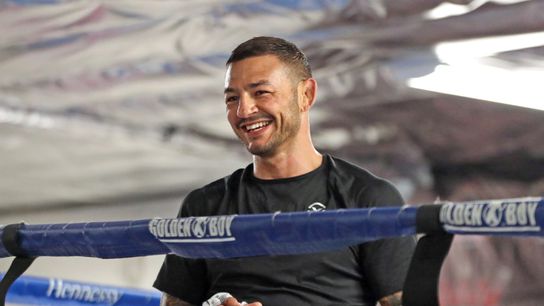
Taya Gray/USA Today Sports
Cub Swanson is not only a UFC fighter, but he also trains and manages fighters, as well.
Getting to where he wanted to be as a fighter in those early days wasn't easy, though. There weren't a lot of qualified MMA coaches and there wasn't a lot on the internet.
Making significant improvement was hard.
"The quality of the athletes and the quality of the fighting is so much better now than when I got in this way back when," Swanson said. "I tell people it's mostly because YouTube and the internet weren't really a thing with MMA back then. As a guy wanting to learn how to fight, you only knew what your instructor knew. It was frowned upon then to bounce around gyms, but to learn something new, you'd have to. We tried to find videos but people in those days didn't want to give out secrets.
"Now, my kids are five years old and they know what guard is and they know what every position is. They can find everyone on the internet they want to learn about the sport. The knowledge is there now. The level of coaching is so much better now. It all adds up."
Swanson is 29-13 and has had a brilliant career. He has notable wins over Dustin Poirier and Charles Oliveira and has fought anyone of substance in and around his weight class over the last two decades. He's on the back end of his career and Saturday's bout could be his last. The one after this might be. He's taking it fight by fight but knows he doesn't have much time left to make an impact as an active fighter.
He's still an entertainer and was given a prime position on the ESPN-televised prelims because of the type of bout he and Fili are expected to produce.
"The UFC put us right in the middle of that card for a reason," Swanson said, beaming. "They know what kind of fight this will be."
He'll continue to impact the game long when he finally walks away from it, though. He's coaching the next generation and said there's yet another level the sport can hit. We're not, he said firmly, at peak MMA at this point.
And his dear friend and long-time manager. Dr. Kami Safdari, died unexpectedly of a heart attack before Christmas in 2020. It devastated Swanson, who is trying to repay Safdari for his help in saving Swanson's life and building his career by taking over his management company and managing fighters himself.
"He was an anesthesiologist and was a great mentor and friend to me," Swanson said. "He was somebody to look up to and who could show me the right way to do things. So I felt like, 'You know what, the right thing to do is to pay it forward. I want to do for others what he did for me.' And so I started managing fighters and trying to help them in their careers but also in their lives to become better people, better men.
"I saw the sport differently when I was first starting and I got fortunate that I went down the path that I have. I never fought for the title, and that kind of stings, but I fought all of these great fighters, you know, guys who were champions and Hall of Famers. And here I am now. So I'm extremely grateful and thankful and I want to do what I can to make the sport better for the next generation, over the next 20 years."