


Eddie Futch said it so often, it echoed in Freddie Roach’s head long after he’d ended his own career as a boxer in favor of training them.
“Whatever you do, kid, don’t open your own gym.”
Futch, the legendary trainer who guided four of the five men who defeated Muhammad Ali, believed that running a boxing gym was a one-way ticket to heartache—busted finances, broken relationships, endless headaches.
Roach listened to most of what Futch told him. It’s why he became one of the greatest trainers of all-time.
The one piece of advice Roach ignored changed everything.
“I told him once, ‘How am I supposed to find the next Muhammad Ali if he doesn’t walk through my front door?’ ” Roach said.
So, he took his last $10,000 and opened the Wild Card Boxing Club on the corner of Hollywood & Vine. He spent his final $50 on 25 flyers and handed them out himself.
Weeks later, alone in the gym, Roach looked up—and there was Ali.
“I remember thinking, ‘Holy shit! Muhammad Ali really did walk through my front door,’ ” Roach said.
Wild Card is now as synonymous with Roach as his horn-rimmed glasses, as much about who he is as where he works.
On Sunday, the City of Los Angeles will honor Roach for Wild Card’s 30th anniversary, and many of the city’s leading dignitaries will attend.
Among those confirmed are the police chief, the sheriff, the district attorney, a council member, an ESPN boxing analyst and more. Mayor Karen Bass may attend.
Roach undoubtedly will tell the story about the time that shortly after the doors opened in 1995 that Ali himself actually strolled in.
“I was going out and handing out the flyers and I wasn’t really getting anything,” Roach said. “And then one day, I was by myself in the gym and sitting at the front and the door opens. I turned to look and there was Ali himself.”
Roach was charging $5 a day to work out then — only recently did he raise the rate for the public from $5 a day to $10 — and Ali’s appearance led to his best day that month.
By that point, Ali was in his mid-50s and more than a decade from his final bout. He’d been diagnosed with Parkinson’s syndrome in the 1980s, a condition that now affects and is closely associated with Roach.
Ali asked if he could work out — and yes, he paid Roach for the time — and hopped into the ring. He later did magic tricks for those who had gathered, though he broke the magician’s code by explaining to all who were listening how he did them.
“He spent seven hours here,” Roach said. “It was just, you can’t even believe it. He was asking me all sorts of questions and doing magic. I had said I needed my Muhammad Ali to walk through that door and then Muhammad himself did. I remember thinking, ‘Is this truly happening?’ ”
More celebrities, superstar boxers and other dignitaries walked through the door in the next 30 years.
One was the boxer who would change his life, Manny Pacquiao. Another was the woman who would become his wife, Marie Spivey.
Courtesy Freddie Roach
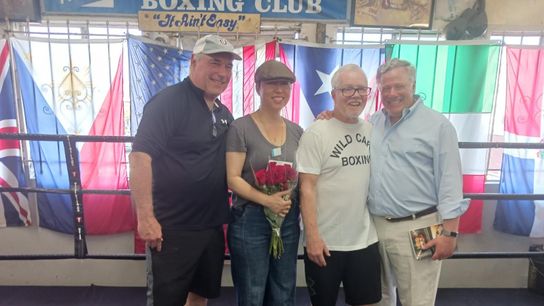
L-R, Stephen "Mac" McDonough, Marie Spivey, Freddie Roach and Fred Sternburg in the ring at Wild Card Boxing Club on June 16, 2023, when Spivey and Roach got married.
Spivey has been a fixture at Wild Card for 22 of its 30 years. She married Roach in the ring at the gym on June 16, 2023, after going from client to employee to girlfriend to eventually business partner and wife.
It was a journey not without its ups and downs.
Theirs has an unconventional and non-traditional relationship, Spivey conceded, because of the way Roach was raised.
His father, Paul, was not necessarily a genteel soul. As a boy, Freddie was caught taking a five-fingered discount at a local store in Massachusetts. When he got home, his father began unloading punches on him, in front of everyone else.
But his older brother got it worse for not having backed his brother.
Roach is still a product of that environment, though he’s become extraordinarily charitable, a giver and someone whose heart leads him to help.
He’s in great pain from his Parkinson’s and cervical dystonia every day, but he rarely lets that on to the public.
Spivey began to get a sense of who Roach was when she began to work for him. He’d asked her out on a date virtually every day for a year, and she repeatedly said no.
He finally asked on her birthday if he could at least take her to dinner on that day, and she finally relented.
She’s the one who keeps the trains on time and on the tracks. And she’s seen up close what Roach has meant to the community and what the community, both in Los Angeles and the boxing community at large, has meant to him.
Lucas Noonan
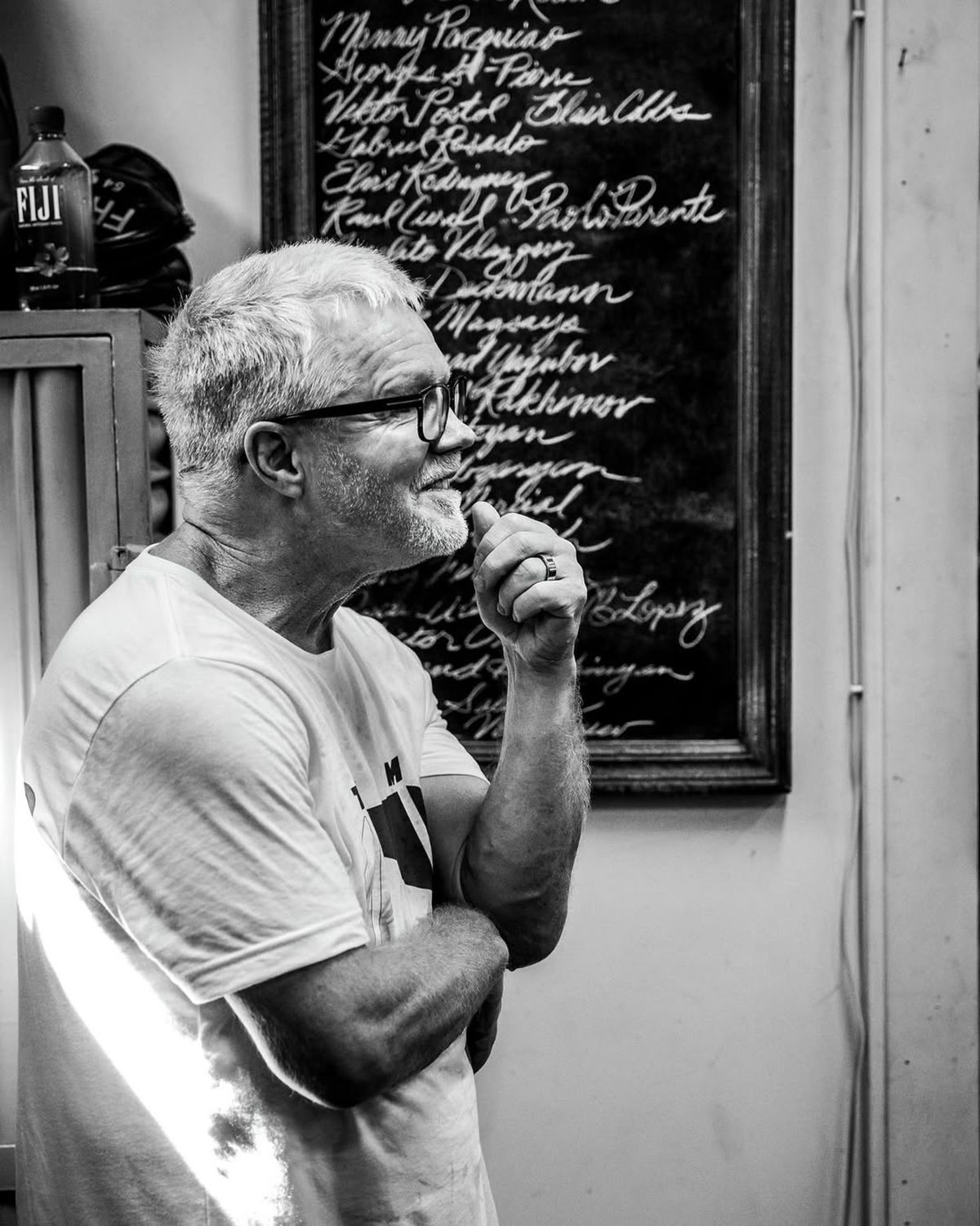
Freddie Roach has won seven Futch-Condon Awards from the Boxing Writers Association of America as Trainer of the Year.
“I see every single side of Freddie,” Spivey said. “He is someone who tries his best to do the right thing. I say that knowing and having to understand what he grew up with, what he saw every day and the challenges he faced.”
By 2001, Wild Card was an established brand in boxing and Roach had long since become an elite trainer. He'd made his reputation by leading Virgil Hill to a world title and had Frankie Liles and Steve Collins win world titles with him in Wild Card's early years.
But in early 2001, Pacquiao was traveling in the U.S., first stopping in San Francisco before heading to Los Angeles. He was staying in a seedy motel behind a Denny’s off of Sunset, just a few blocks from Wild Card.
He walked in with his manager, Rod Nazario, and asked if Roach would hit mitts with him.
Roach jumped in the ring and was astonished by the speed and power Pacquiao displayed. After the first round, both men returned to opposite corners.
Roach said, “I think I might have found a new fighter.” Pacquiao didn’t equivocate.
“I have found my new trainer,” Pacquiao said.
They formed arguably the greatest team in boxing history. Both made it into the International Boxing Hall of Fame, and all seven of Roach’s Trainer of the Year awards came while he was training the Filipino legend.
Roach went on after coaching Pacquiao to train many of the modern era’s greatest, including Mike Tyson and Miguel Cotto, among many others.
He knows, though, who made it all possible.
“I owe so much to Manny Pacquiao,” Roach said.
Pacquiao, though, owes Roach an enormous debt of gratitude.
Roach and Pacquiao were like Casey Stengel and the Yankees, perennial winners and seemingly always getting better.
Roach will grudgingly admit now that Futch was right about the headaches owning a boxing gym presents. Roach has lived them all.
He’s also lived shoulder-to-shoulder with boxing royalty and some of the biggest names from politics, business and pop culture of the last three decades.
Another big name who followed Ali and Pacquiao through those doors is the former presidential candidate and civil rights leader, the Rev. Dr. Jesse Jackson. Jackson has been diagnosed with Parkinson’s disease, and Roach has helped him tremendously and provided advice and support.
Roach, though, proved that he knew what he was doing by ignoring Futch’s advice.
Muhammad Ali himself walked through that door. So did an unknown Filipino who teamed with Roach to change their lives as well as the course of boxing history.
Thirty years later, the doors remain open, and the ghosts still walk in.

Lucas Noonan
Freddie Roach (L) holds the mitts for world champion Manny Pacquiao.