


Let’s start with a simple, undeniable fact: If every boxer pursued greatness and chased history with the passion and purpose that Claressa Shields does, the sport would be vastly healthier than it is today.
Shields is frequently outspoken, sometimes bombastic and never hesitates to confront someone when she disagrees with them. She’s not for everyone.
She’s brash and refers to herself as “The GWOAT,” an acronym for the Greatest Woman of All-Time.
That type of talk turns off plenty, and it started long before she was born into poverty in Flint, Mich., in 1995. Muhammad Ali called himself “The Greatest,” and turned legions of fans against him.
Like her or not, though, it’s impossible to dismiss Shields’ accomplishments. She’s one of the most accomplished boxers in U.S. history.
Consider this:• 2012 and 2016 Olympic gold medalist at middleweight.
• Professional world champion at super welterweight, middleweight, super middleweight, light heavyweight and heavyweight.
• Undisputed world champion at super welterweight, middleweight and heavyweight.
• 16-0 with three knockouts as a pro.
• 77-1 with 18 knockouts as an amateur, with her only loss coming as a 16-year-old to Savannah Marshall.
What she’s done is extraordinary, and even with a feature film made about her life, it still hasn’t received the attention it deserves. Some will dismiss her feats as contrived and note there is little talent in the heavier weight classes in women’s boxing, but if it were so easy, why hasn’t it been done before?
There simply aren’t a lot of highly athletic women over 175 pounds who box, thus somewhat diluting that accomplishment in the eyes of some.
Shields thinks big, in historic terms, and it’s why she’s become an iconic figure within the industry. She dropped a bomb at a media workout in New York on Tuesday to promote her July 25 heavyweight title fight against Lani Daniels.
She told Ryan Songalia of BoxingScene she’d consider competing for a third gold medal at the 2028 Olympic Games in Los Angeles. If she pulls it off, she’d become:
• The fourth boxer, and first woman, to win three golds, joining Hungary’s Laszlo Papp (1948, 1952 and 1956); Cuba’s Teofilo Stevenson (1972, 1976 and 1980) and Cuba’s Felix Savon (1992, 1996 and 2000).
• The first American to win Olympic boxing gold since she did it in Rio de Janeiro, Brazil, in 2016.
• The only American to have won a gold medal in boxing since Andre Ward did it in Atlanta in 1996.
“If America wants to get another Olympic gold medal, you put Claressa Shields in the 2028 L.A. Olympics, that’s what you’re doing,” Shields told Songalia.
The question is, can Shields do more for women’s boxing by staying professional and racking up more accomplishments or by returning to the Olympics and chasing another gold.
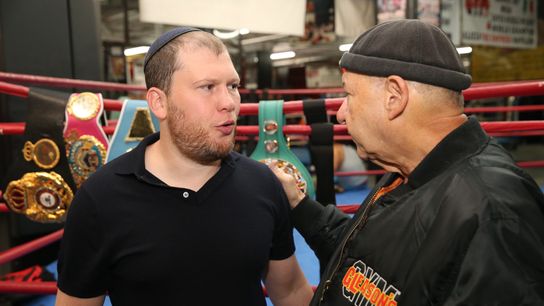
John Giamundo/Salita Promotions
Promoter Dmitriy Salita (L), shown talking to Bruce Silverglade of Gleasons Gym, compared Claressa Shields to Muhammad Ali.
NBC will broadcast the 2028 Games, and as it has done, will stream many of the events while putting others on its various cable channels.
It’s only speculation, but NBC has shown little love for Olympic boxing, and it’s a fair question to wonder if Shields makes the Olympic final whether NBC would air her gold medal bout on its main network, where the most people could see it.
Her promoter, former boxer Dmitriy Salita, thinks it would be massive if she chose to do that, though he conceded it’s more difficult to create stars now than it was in, say, 1976 when a U.S. team that included Sugar Ray Leonard and Michael and Leon Spinks won five golds and were major stories in every newspaper.
“Back in the Seventies and Eighties, there was three or four TV channels, no internet and no social media,” Salita said. “The world was centered on the Olympics, not only in the United States, but throughout the world. Heroes in sport were thus very easily defined.”
The competition is so much greater now than it was in 1976 when Leonard’s story was the centerpiece of the Montreal Games and he became a household name overnight.
Entertainment options abound, beyond sports, and in the sports that are less popular among the masses, it’s more difficult to get attention.
Salita is a brilliant young promoter who has done much to help rebuild boxing in Detroit, but he sees the challenges of creating stars in this environment.
“Today, to define a hero in sport and promote someone isn’t as easy as it was back in those days,” Salita said. “It’s a lot harder to do today. But those special, rare athletes, like Muhammad Ali, like Jackie Robinson, like Michael Jordan, they are driven by something inside them to defy the odds and to do things that weren’t done before.
“And that translates. When Claressa went back in 2016 for that second gold medal, it wasn’t for the money. She has that thing that separates her, a deep fire and desire, to be the best and to do things others say can’t be done.”
If NBC doesn’t put her on the network, will it be worth her while? She’ll be 33 then, but would be an extraordinary favorite to win the gold.
Joining Papp, Stevenson and Savon would be an extraordinary story in the boxing world, but would it crossover to the mainstream? I have my doubts.
Salita, though, does not. Shields, he pointed out, uses her prominence as an athlete to push social causes.
In an interview I did with her in 2020 for Yahoo Sports, Shields talked about the perception that is painted of her, but she shrugged it off. Ali, too, was demeaned by many in his time.
“I want to make history because I want to be an inspiration for women and show them that they can do whatever they put their minds to doing,” Shields said in 2020. “There are people in the media who paint me as a thug, and people criticize me for talking and expressing the truth, but that’s what you have to deal with when you’re making history. I ain’t bothered by it because I know what is real and what isn’t.”
A third gold medal is very real if she chooses to pursue it. Whether it will give her the platform she wants is another story.
Salita, though, thinks it will.
“To me, she is the Muhammad Ali of this generation,” Salita said. “She’s also a social icon. For her to go and fight in Africa and in the Middle East is something I’ve been talking about for years because of who she is and what she represents. If she [wins a third gold medal], it would be worldwide news, not just in the U.S., and it would obviously raise her profile and the profile of women’s boxing and women’s empowerment with it.
“Great people use the talents they’ve been blessed with to make the world a better place. Claressa uses that boxing skill as a bridge, as a vehicle to promote what’s important to her, which is equality. … There are many initiatives to that movement. She’s at the peak of her career, is one of the greats, and has a lot more still to accomplish.”
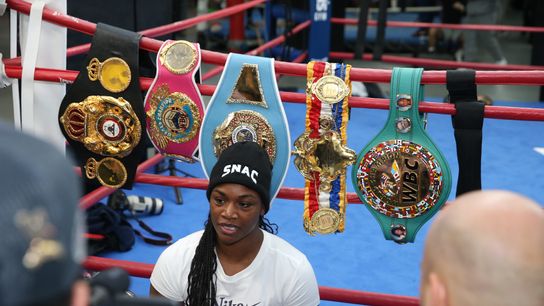
John Giamundo/Salita Promotions
Undisputed heavyweight champion Claressa Shields discusses a potential run at a third Olympic gold medal with the media Tuesday in New York.