


Moses Itauma steps into a boxing ring with the calm of one who knows how the story will end. There is an aura of invincibility and inevitability that surrounds the 20-year-old heavyweight.
He’s fast, powerful, and frighteningly poised. He’s got the tools to be a household name.
The world wants to see him sprint those final steps to greatness.
Mike Tyson made history on Nov. 22, 1986, when he knocked out Trevor Berbick in the second to become, at 20 years, four months and 24 days, the youngest heavyweight champion ever.
A year ago, much of the effort to introduce Itauma to the wider public hinged on the idea that he could break Tyson’s feat.
It would have been a remarkable feat had he pulled it off, but in the big picture, it means nothing.
Haste makes waste, and this guy’s got far too much potential to waste chasing a meaningless standard.
An elite heavyweight champion lifts boxing. Think of what guys like Jack Dempsey, Joe Louis, Muhammad Ali and Iron Mike did for the sport.
Itauma could have a massive impact on boxing as a whole if he maximizes the potential he’s oozing. Going too fast might not just ruin his career, but could also hurt the sport itself by ruining a potential star.
To truly fulfill his potential, Itauma must be prepared for the elite challenges that currently define the heavyweight landscape.
A fighter like Oleksandr Usyk, the unified heavyweight champion, isn’t going to fold the first time he eats an Itauma hook.
That is, if he ever eats one; Usyk is a brilliant defensive fighter who knows how to make an inexperienced opponent look silly. When Itauma finally stands across from Usyk, he'll need to understand what Usyk is trying to do and how to counteract it.
On July 19, Usyk will meet IBF champion Daniel Dubois for the undisputed belt. Dubois is 27 and improving so rapidly that it appears he can be the next face of the division if he continues down the same path.
There are elite contenders, including Joseph Parker, Anthony Joshua and, if he comes out of retirement, Tyson Fury, who are deservedly ahead of Itauma in the title shot line.
The fruit is not yet ripe, and pushing him too soon risks the entire harvest. Instead of mere rounds, Itauma needs resistance. A little pushback would be good for him.
He needs to have faced a serious challenge by the time he fights for the belt. He needs to face adversity. He needs to stand across from someone who can not only take his best shot but take it and fire back.
Itauma needs to understand how to win when things don’t go well, or he’s not on top of his game, or his opponent raises his game.
On Saturday in Glasgow, Scotland, he obliterated veteran Mike Balogun, stopping the ex-NFL player in the second round. It was no contest from start to the vicious finish.
The way Itauma ended it, catching Balogun with a right hook while in retreat, is the kind of highlight you don’t forget. Balogun went down face-first and Itauma had made a statement.
Itauma placed his shots well and was economical with his punches. He showed good feet and was always in punching position. And when Balogun tried to turn it into a brawl, Itauma remained poised, kept his distance and showed his frightening power by decking Balogun twice in a round that didn’t last a minute.
Balogun was credible, but even on his best day, with Itauma at his worst, the outcome was pre-ordained.
That’s the trick. How much did pummeling a 41-year-old guy, dropping him three times and stopping him 46 seconds into the second round actually help Itauma improve?
Matchmaking in boxing is an art. A promoter doesn’t want to get an elite prospect beat if he doesn’t have to, but he shouldn’t simply want to feed him a diet of tomato cans that don’t help him grow his skill set.
Promoter Frank Warren said he's considering Otto Wallin and Jermaine Franklin as Itauma's next opponent. Itauma mentioned fighting Zhilei Zhang or Filip Hrgovic. The trick is to push him while not overwhelming him. Zhang, for instance, is big and powerful, but terribly slow and so Itauma's speed and quickness would likely enable him to handle the Chinese slugger.
The genius of Top Rank’s Bruce Trampler was proven in the way he matched Oscar De La Hoya and Floyd Mayweather as they were on the rise.
Trampler knew that one day, when both Mayweather and Diego Corrales were contenders, they’d likely fight in an important bout. So he put Mayweather in with Tony Pep, who at 6-1 1/2 was taller and rangier than the 5-11 Corrales.
Pep pushed Mayweather all 12, but “Pretty Boy Floyd,” as he was then known, learned how to deal with someone with that kind of height and reach. When he fought Corrales, it wasn’t new to him. He dropped Corrales five times and stopped him in the 10th.
Pep had the same ability to beat Mayweather — none — as Balogun did Itauma. Pep, though, taught Mayweather some valuable skills.
The goal for Itauma is not to fight for the heavyweight title at a young age, but to win it and then keep it. If he fights in late 2026 or early 2027, he’ll still only be 22 years old. He can get six or even eight fights in during that time, and be fed a diet of opponents who will push him and force him to improve.
There’s no rush. It took Leonardo da Vinci 16 years to finish the Mona Lisa. Greatness takes time.
Itauma has a rare talent and an undeniable presence. He has the things that can’t be taught.
He has Ben Davison, one of the best teachers in the business, showing him the nuances. If Davison is given time to work his magic, Itauma won’t just rise.
He’ll be built to last, and arrive at the place where invincibility meets inevitability.
Combining shrewd matchmaking with Davison’s sharp teaching will create a champion whose calm stems not from youthful bravado but from hard-won experience.
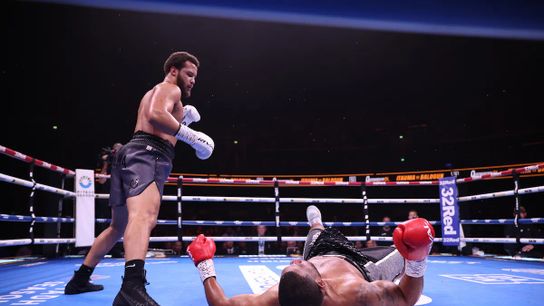
Leigh Dawney/Queensberry Promotions
Moses Itauma (L) is 12-0 with 10 KOs.