


He punished you with his fists, but he really beat you with his feet. His footwork seemed at times a form of rebellion against the laws of physics. In a sport where flat feet get you hurt and hesitation gets you beat, it was a ballet with bad intentions for Vasiliy Lomachenko.
He was known as “The Matrix,” and for once, the nickname had authenticity. Opponents would freeze mid-attack as he pirouetted through angles that shouldn’t exist, that only he saw. He’d be just out of reach, and almost surreptitiously would slip in to punish with precision, then ghost out before his opponent could process what had happened.
It wasn’t flash, nor was it sorcery. It was geometry inside a boxing ring, a combination of vision, muscle memory and years of repetition that he applied with surgical cruelty from the first day of his professional career.
Between 2015 and 2018, he won eight consecutive fights by knockout. Four of those ended with his opponent surrendering on their stool.
It happened so often they gave him a nickname to match: “Nomaschenko.” He was at his peak, arguably the greatest boxer alive at that point.
Fighters didn’t finish bouts with him. They survived them.
As great as he was, he lost to the one opponent who defeated every legendary athlete: Time.
Lomachenko announced his retirement on Thursday, beginning the countdown to his Hall of Fame induction.
The numbers on his amateur career — 396-1, two Olympic gold medals, two amateur world championships and one runner-up — were something out of a video game.
Expectations for his pro career were extraordinary, and he somehow exceeded them.
His greatness wasn’t built by pummeling tomato cans or the stars of the Bum of the Month Club to create a phony record. It was forged against elite competition.
He was so intent on fighting the best that when one opponent dropped out, promoter Bob Arum offered a replacement. Lomachenko said “absolutely not,” and called the proposed opponent “too easy” and “a waste of my time.”
From the moment he turned pro, he demanded the toughest fights available. In his second pro bout, he fought for the world title, and lost a questionable decision to a guy who missed weight.
In his third fight, he delivered the performance of a lifetime. He was Gale Sayers scoring six touchdowns against the 49ers or Mario Lemieux scoring five goals in five ways versus the Devils. It was the kind of excellence that forces jaws to drop.
He was breathtaking.
He was brilliant.
Over the next decade, he built a resume as rich as any fighter of his generation. He believed greatness required risk so he sought out monsters when his name alone on the marquee would have filled arenas.
He was a breathtaking combination of offense and defense, of physical excellence and mental mastery.
“He wasn’t just a defensive fighter,” Arum said. “He used those great defensive abilities he had to create offense. In essence, his defense had a purpose, and his purpose was to find a weakness in his adversary and then exploit them.”
Because he couldn’t find enough opposition at featherweight, where he was most natural, he moved up to 130 and then 135. When he did fight someone his own size — two-time Olympic gold medalist Guillermo Rigondeaux — it was a surgical execution.
“I don’t think Rigondeaux was past it at that point,” Top Rank vice president Carl Moretti said. “Everyone was calling for it at the time. We had two guys who had four gold medals between them and it wasn’t even close.
“He beat him mentally, he beat him physically and he just broke him down. Rigondeaux said he hurt his hand, but he didn’t throw punches so I don’t know where he would have gotten hurt.”
He entered the pros with what may have been the greatest amateur résumé in boxing history — one loss in 397 fights, and even that defeat avenged.
But Lomachenko never let the past define him. He could have coasted on what he’d already done — the gold medals, the record, the myth — but instead, he demanded more of himself. He wanted harder fights. Heavier men. Harsher roads.
He didn’t just meet expectations. He crushed them.
Now that it’s over, the record books will reflect the titles, the knockouts, the brilliance, his ability to make boxing beautiful.
But those who watched closely will remember something more: a fighter who moved like no one else, thought like no one else, and carried himself like a man who never needed to prove anything — and still proved everything.
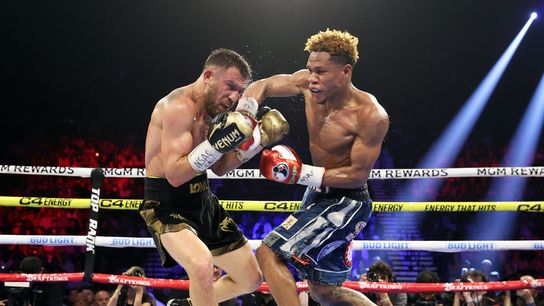
Mikey Williams/Top Rank
Vasiliy Lomachenko (L) battled Devin Haney in a 2023 lightweight title bout.