


Many of today's star boxers grew up idolizing Oscar De La Hoya. Oh, how much better the sport would be if more of them emulated his actions in the ring. If today's fighters were as active as De La Hoya was during his prime and regularly sought out the best challenges, this sport would be a lot healthier.
De La Hoya was one of the great fighters of his era, and among the best to ever step foot into a boxing ring. An Olympic gold medalist in 1992 and a six-division world champion as a pro, De La Hoya justifiably was chosen for induction into the International Boxing Hall of Fame the first time he was eligible.
He remains one of the most important fighters in the sport's history. He helped usher in the pay-per-view era, and set a standard by constantly seeking out elite opposition.
He also fought regularly, which not nearly enough of today's stars do. Between 1995 and 1997, as he moved into his prime, De La Hoya fought 14 times, winning them all. He faced men who had a combined record of 483-21-8. He made four lightweight title defenses in 1995. In 1996, he won a super lightweight belt and defended it once and in 1997, he won a welterweight title and defended it three times.
In 1997, he fought the great Pernell Whitaker in a bout billed for pound-for-pound No. 1 status. Talks didn't drag on for years to make the fight. It was one people wanted to see, it was important for the sport and it quickly got put together.
Though things are getting better, boxing still doesn't do that regularly enough to help pull it out of the doldrums.
We need to see boxers like Terence Crawford, Naoya Inoue, Oleksandr Usyk, Gervonta Davis, and others like them three or four times a year. Crawford is the best pound-for-pound boxer in the world, but you have to go back to 2019 to find a year in which he fought more than once.
Crawford hasn't competed three times in a calendar year since 2016. Inoue hasn't since 2017, Usyk hasn't since 2018 and Davis hasn't since 2019.
Each of them are great fighters and are heading toward Hall of Fame induction. But none of them are nearly the level of star De La Hoya was and their relative inactivity is a major reason why.
Consider what De La Hoya did as he was moving into primetime status:
De La Hoya didn't appear just on pay-per-view, but also fought on HBO, keeping his name in the spotlight. Davis, by contrast, has fought just 13 times in the nearly eight full years since he won his first world title. The business would be far better off with Davis fighting frequently, and his influence on the sport would be far greater if he did.
Today’s top fighters are paid so much that they lack motivation to compete more often, even though they rarely generate the revenue to justify those exorbitant purses. And without them competing regularly, the sport isn't nearly all it could be.
Way too many of today's elite boxers lean more toward Davis' activity level and less toward De La Hoya's. But fighting frequently not only keeps one sharp, it also helps build and enhance a profile.
Boxing as a sport has been marginalized for many reasons over the years. It's not going to be fixed overnight, but those who earn a living from it must work toward the goal of revitalizing it. Having its stars fight regularly is one way of accomplishing that.
But one fight we were hopeful of getting is now almost certain not to occur. Rick Mirigian, the manager of unbeaten Vergil Ortiz, the interim WBC super welterweight champion, said a potential Feb. 22 bout with IBF welterweight champion Jaron Ennis is not going to take place.
Mirigian said the bout "is beyond dead," and said Ortiz wouldn't give Ennis a consideration moving forward.
Most of us learn at a young age that if something seems too good to be true, it probably is. That's what it appears the plans for a Feb. 22 super card look like it's turning out to be. If the card that was proposed for Feb. 22 moves forward in largely the same manner, it's still a very good card, but it's not what it could have been.
And that says so much about the state of boxing as we head into 2025.
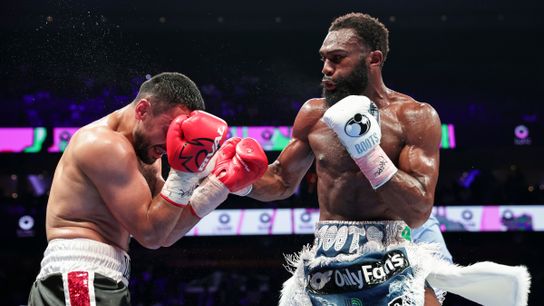
Jaron Ennis (R) is no longer going to fight Vergil Ortiz in February.
UFC CEO Dana White grew up a boxing fan and still remains a massive fan of the competition, though not of the business. He said in an interview with me earlier in the year that while he's planning to be involved in boxing in 2025 in one way or another, the myriad problems it faces often give him pause.
"Boxing doesn’t f*cking work [from a business standpoint]," White said. "You need a Saudi trillionaire to make f*cking fights, and even Saudi trillionaires get tired of the f*cking bullshit."
White’s critique underscores a key flaw in boxing’s structure: Without a cohesive system to consistently deliver high-quality matchups, the sport struggles to sustain momentum.
The loss of one fight from an otherwise strong card isn’t cause for panic. But the Saudis have generally well overpaid since entering the sport. The Saudi cash has facilitated once-unthinkable fights but also essentially encouraged fighters to hold out while they wait to hit the jackpot.
De La Hoya’s bouts against David Kamau, Oba Carr, and Jesse James Leija weren’t superfights but were crucial for his development and for building his name against hard-nosed veterans. While the Saudi model has focused on blockbuster events, De La Hoya’s rise shows the importance of consistent, solid fights to build a boxer's name and sharpen their skills.
As a result of focusing mostly on the mega-events, a lot of boxers sit inactive awaiting a big score and fans tend to forget about them. Led by Turki Alalshikh, the Saudis need to work with the promoters to find the right balance. Their wealth enables them to create big fights, but tying fighter purses to both in-ring performance and consistent activity could incentivize fighters to stay active and help build their legacies.
Encourage the fighters to take part in the promotion of their bouts. Incentivize them to sell the shows because a great performance is meaningless if few see it.
The sport has so much potential, and can be breathtakingly great at its best. Far too often, though, the fighters and their managers want to milk it for what they can get out of it, and they don't give back enough. So it creates a situation where boxing is marginalized and gets a smaller share of the overall entertainment pie each year.
Sooner or later, they have to realize, as Billy Preston sang in his 1974 hit, that nothing from nothing leaves nothing.
De La Hoya set a great example by proving that consistent activity and ambition build both a legacy and a fortune. It’s time for today’s fighters to follow suit.