


UFC CEO Dana White has frequently said he “sells Holy Shit!” moments for a living.
But can TKO executives Ari Emanuel and Nick Khan turn those moments into a billion-dollar a year broadcast deal, especially in an era of PPV fatigue, rising prices, and a shortage of American megastars?
We’ll soon find out, though it’s never wise to bet again Emanuel and Khan. They’re the Jon Jones and Islam Makhachev of brokering rights deals.
The UFC’s rights agreement with ESPN ends this year, and its exclusive negotiating window with the network ends next month.
The UFC stages roughly 550 fights per year across 45 events, a relentless schedule that ensures year-round live content —something traditional networks and streaming platforms crave.
It also has 80 to 90 percent of the world’s greatest fighters under contract.
Despite that, a furor in the MMA media has popped up about the UFC’s lack of star power.
And while there is no American megastar equivalent to Conor McGregor, Ronda Rousey or George St-Pierre, the UFC has plenty of fighters with significant followings outside the U.S.
There are nearly 50 UFC fighters with 1 million or more Instagram followers, topped by McGregor at 46.85 million. He is followed by Makhachev at 10.06 million, Khamzat Chimaev at 9.56 million and Jones at 9.51 million.
Those numbers would suggest there is no such issue, but MMA has increasingly become a global sport.
In 2024, the UFC put on 51 live shows, including 10 Contender Series episodes. Those shows took place in 10 countries (U.S., Canada, Mexico, Brazil, Saudi Arabia, England, United Arab Emirates, Australia, France and China) and in nine states (Nevada, California, Florida, New Jersey, New York, Missouri, Kentucky, Colorado and Utah).
As the sport has grown in areas like Eastern Europe, the Middle East, France and Australia, American stars have been bypassed. There are only three U.S. born champions.
The UFC’s pay-per-view sales are down, but pay-per-view is a dwindling business and the lack of familiar names hurts sales in the U.S, but increases exposure elsewhere.
ESPN and the UFC did a deal in 2018 that began in 2019 that was worth $1.5 billion.
In 2018, UFC PPVs cost $59.99. Today, they’re $79.99, a 33 percent jump at a time when buyers are dealing with inflation and economic uncertainty.
That’s a tough ask, especially when fewer fights feature U.S. stars that casual fans recognize. The UFC’s strategy of taking its live show around the world has helped its global reach to explode, even while domestic PPV sales have slumped.
Business was booming on pay-per-view during the pandemic, partly because for a while, the UFC was the only one putting on live sports. White said PPV shows in the early days of the pandemic were massively over-performing expectations.
“We had some pay-per-views that we figured we would do here (putting his hand at his waist) which wound up doing here (putting his hand above his head),” White said last year.
As Emanuel, Khan and the TKO team negotiate the next broadcast deal, the question that is fair to ask is simple: Are there enough American stars to keep them reaching into their pockets and buying pay-per-views?
The UFC’s 11 champions represent seven countries:
• Three Americans (Jon Jones, Belal Muhammad & Julianna Peña).
• Two Russians (Magomed Ankalaev & Islam Makhachev).
• Two Georgians (Ilia Topuria & Merab Dvalishvili).
• One Brazilian (Alexandre Pantoja).
• One South African (Dricus Du Plessis).
• One Chinese (Zhang Weili).
• One Kyrgyzstani (Valentina Shevchenko).
File
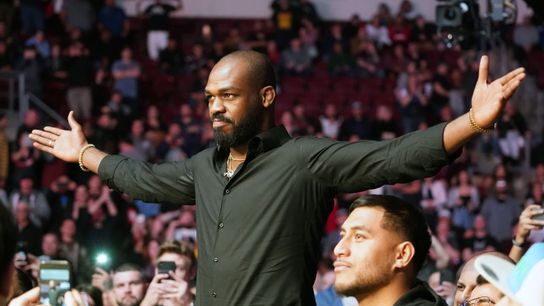
Jon Jones is one of three American UFC champions.
As non-English-speaking champions and contenders dominate, the role of interpreters like Sergey Nagorny and Fabiano Buskei has grown. Their presence highlights a shift: The UFC’s biggest stars now speak a language most of its U.S. audience doesn’t.
That’s a challenge, and an opportunity. It forces the UFC to either embrace its global audience fully or find new ways to develop and market homegrown talent.
I spoke to more than a dozen people for this story who have experience in the fight game and the television business.
Almost to a person, the consensus was that the financial deal the UFC receives is going to be astronomical.
If the UFC agrees to a rights deal with a global service like Netflix, it will reach a worldwide audience that was 301.63 million subscribers at the end of 2024.
The UFC’s ESPN rights deal began in 2019 when Netflix had 167.1 million subscribers.
Today, Netflix has 301.63 million subscribers, a staggering 80 percent increase.
Courtesy Most Valuable Promotions
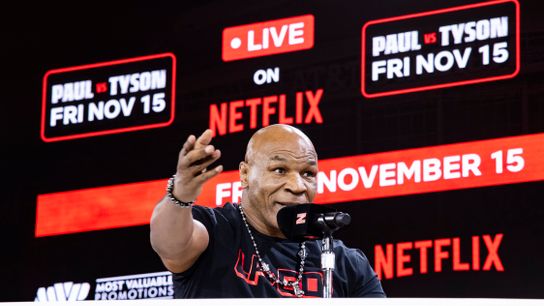
Mike Tyson's Nov. 15 fight with social media influencer Jake Paul was viewed in 65 million households worldwide on Netflix.
At that growth rate, it could surpass 500 million by 2031, making it the most dominant content platform on Earth.
If UFC jumps to Netflix, it wouldn’t just expand, it’d be a seismic shift in how combat sports are consumed worldwide.
The careers of fighters are short, and the UFC has been wise almost from the moment White and partners Frank and Lorenzo Fertitta purchased the company in 2001 to focus on the brand.
The Contender Series has proven to be an incredible tool to develop new talent, and its 2024 season produced some of the best prospects yet.
White has never worried about where the fighters are from because he believes it crosses barriers.
“Fighting is the sport that crosses all borders,” White said. “I don’t care what color you are, what country you come from or what language you speak, fighting is in our DNA. We get it and we like it.”
Part of that quote is on the wall at the UFC Performance Institute in Las Vegas, where so many fighters come to prepare for their bouts.
A punch in the nose is the same in English as it is in Spanish, Portuguese and Russian.
The UFC still has plenty of stars. Maybe not a McGregor or Rousey, but look at their social media pull: They have millions of followers, with international appeal. The star power is there. The question is, do American fans care enough to buy in?
Makhachev is massive in the Middle East and Eastern Europe, a part of the world the UFC is mining. Women's strawweight champion Zhang Weili has a large, passionate following in China.
Topuria, who lives in Spain, may help turn that country into an MMA hotbed the way Michael Bisping did in England and Alex Volkanovski did in Australia.
The world is changing and the makeup of the UFC’s roster is changing with it.
White’s “holy shit” moments don’t change, though.
Fans are still drawn to a violent knockout or a lightning fast submission, no matter what language they speak.
The UFC has done something unprecedented in sports. It has made the name on the front of the jersey more valuable than the names on the back. Fans tune in for the letters ‘U-F-C’ now, not just the next McGregor, Rousey, or GSP.
Emanuel and Khan won’t be selling an American star. They’ll be selling a sport that has outgrown borders, outlasted trends, and remains as compelling as ever. That’s why when the UFC’s next broadcast deal drops, it’ll be a jaw-dropper.
The UFC’s next broadcast deal won’t be driven by who’s holding the belts. It’ll be driven by something more powerful: The realization that fighters come and go, but the brand is forever.
File
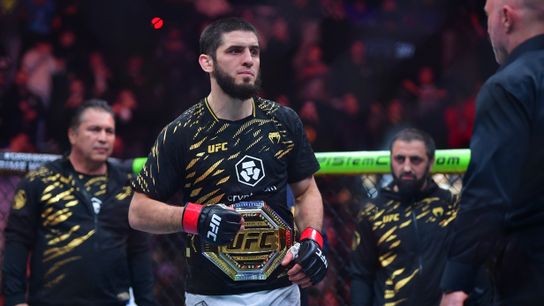
UFC lightweight champion Islam Makhachev has more than 10 million followers on Instagram.