


Barely 16 and determined to make weight for his pro debut, a fresh-faced Manny Pacquiao stuffed rocks in his pockets so he’d meet the minimum requirements.
That desperate measure on January 21, 1995, in the Philippines, marked the humble beginning of a journey that would transform him into one of the most recognizable figures in the world, and now, a Hall of Famer.
The next night in Sablayan, Philippines, the scrawny kid who was raised in abject poverty won a four-round decision over Edmund Enting Ignacio.
It was the first step of a journey that, on Sunday, takes him to Canastota, N.Y., where he will be inducted into the International Boxing Hall of Fame.
There’s normally a finality to a Hall of Fame induction, but about six weeks later, Pacquiao will return to the ring in Las Vegas on July 19 to challenge Mario Barrios for the WBC welterweight title.
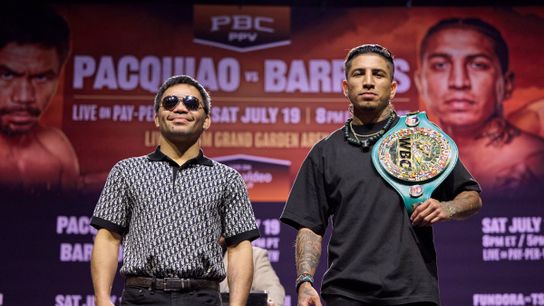
Pacquiao was 3-0 by the time Barrios was born in 1995.
He’d go on to become one of the greatest boxers who ever lived and set records that future stars will struggle to match.
“I think he’s Top 25 because obviously he had this great career, but look what he accomplished later in his life,” said Sean Gibbons, the head of Pacquiao’s MP Promotions and one of boxing’s sharpest minds.
“He beat [Keith] Thurman for the title at 40 years old and nobody in the history of boxing [at welterweight] — Not Sugar Ray Robinson, not Sugar Ray Leonard, not [Oscar] De La Hoya, not [Floyd] Mayweather — nobody at 40 years old did what Manny did.”
He’s defied the odds repeatedly through a career in which he’s won 62 times and earned titles in a staggering eight weight classes.
He’ll face an uphill battle in July because he’ll be more than a 3-1 underdog against Barrios.
Pacquiao's return, though, echoes a familiar and often heartbreaking refrain in boxing: the sport's tendency to punish its own legends.
Joe Louis was an American hero, but he made a comeback in 1951 because the government was chasing him for back taxes. He suffered a brutal beating at the hands of Rocky Marciano in a heavyweight title fight that not even Marciano wanted to do.
Muhammad Ali suffered a similar fate, getting drilled by Larry Holmes in 1980 in a non-competitive bout and then lost to Trevor Berbick in 1981.
Leonard came out of a six-year retirement in 1997, was blasted out in five rounds by Hector Camacho, and finally, mercifully walked away for good.
Even Pacquiao was involved in one of those fights.
Esther Lin
Manny Pacquiao (L) was 3-0 when Mario Barrios was born in 1995.
His career was made, in large part, by a 2008 battering he delivered to a finished Oscar De La Hoya, one of his era’s great fighters whose magnificent career came to an ignominious end when he had to quit on the stool after being mauled by Pacquiao for eight rounds.
The majority of the greatest fighters come from the most impoverished backgrounds; rarely do rich folks send their children into boxing.
Legends like Ali, Louis and Leonard got rich off of their talents, but most of the sport’s superstars came from nothing and had no clue how to handle their wealth.
They eventually had to risk their health and compete again because they were broke.
“So many of them fought too long because they were just down on their luck and needed the money,” Hall of Fame matchmaker Bruce Trampler said. “It’s the one thing they can do and the one way they can make [big] money in one fell swoop.
“I’m not saying this is the case with Manny. I don’t know his situation now. I’m just saying we’ve all seen these guys retire and unretire a hundred times, and almost always it’s because they need the money.”
Pacquiao will be more than halfway to 47 when he steps into the ring to face Barrios. He insists his finances are in order and said his passion is what has brought him back.
After he lost his bid for another term in the Filipino senate last month, he accepted the offer to chase another belt against Barrios.
It’s one of the riskiest bets of his epic career.
Following his Aug. 21, 2021, loss to Yordenis Ugas, he was melancholy and seemed to suggest he was done.
“I’ve done a lot for boxing and boxing has done a lot for me,” Pacquiao said after losing to Ugas. “I look forward to spending time with my family and thinking about my future in boxing.”
On Tuesday, Pacquiao was upbeat and eager as he attended a news conference in Los Angeles with Barrios to formally kick off the fight’s promotion.
It was typical Manny as he praised his opponent and said he hoped to give the fans their money’s worth.
He doesn’t need to fight Barrios to pay the bills, but he needs to fight him to fill that competitive urge that still bubbles up.
“The fire, determination and eagerness to work hard is still there,” Pacquiao said. “I’m still enjoying running the mountains. Not every fighter has this feeling. This is a blessing, because I’ve been through so many big fights in my career and I’m still here. I’m back.”
For how long he’s back is anyone’s guess. He will begin sparring shortly, but Gibbons said his quickness and reflexes still look elite.
This is a guy who could have stood toe-to-toe with the greatest of any generation and more than held his own. He’s now going into a bout against a good, but not great, opponent as a significant underdog.
That’s due almost totally to the 16 years between them, because Pacquiao has a resume that few in the history of the sport could match.
The decade of the 1980s was filled with fighters who would have made sensational bouts with Pacquiao.
Think of guys like Leonard, Roberto Duran, Thomas Hearns, Aaron Pryor, Alexis Arguello, Julio Cesar Chavez, Roger Mayweather and Salvador Sanchez, among others. Pacquiao would not have been out of place in fights with them, Trampler said.
“Manny would have been competitive in any era,” Trampler said. “In his prime, he’d have been even money with Mayweather. When they fought, we know Manny had that shoulder injury that needed surgery. Healthy, both of them in their primes? That’s a 50-50 fight.
“Manny and Duran? Manny wouldn’t have stopped him like Hearns stopped Roberto, but he could have beaten him.”
Trampler said Pacquiao’s greatness was fueled by exceptional athleticism. Gibbons was more specific.
It was Pacquiao’s footwork that set him apart.
“His feet set everything up,” Gibbons said. “Off of his feet, he was able to throw punches from so many angles. [Miguel] Cotto couldn’t tell if it was Manny, the referee or another guy throwing punches [at him]. He had no idea where the punches were coming from and that’s what made Manny great.
“You start with the great feet as a foundation and it allowed him to do so much else. He’d throw a shot and do that hop and he’d be on the other side of you before you knew it and he’d land three, four punches before you could react. His legs were always his greatest attribute. He was never just in front of you. That’s why he’s the Pac Man.”
At 46, he’s still the Pac Man, driven by an unyielding fire that defines his legend. Yet, as he steps into the ring once more, the question lingers: is this a final, glorious chapter, or will the very qualities that made him immortal ultimately make him the big-game trophy for a younger, hungrier generation to hunt down?
Imagn Images
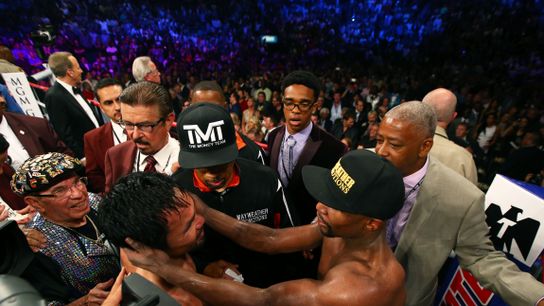
Floyd Mayweather (R) and Manny Pacquiao met in a huge-money bout in 2015.